

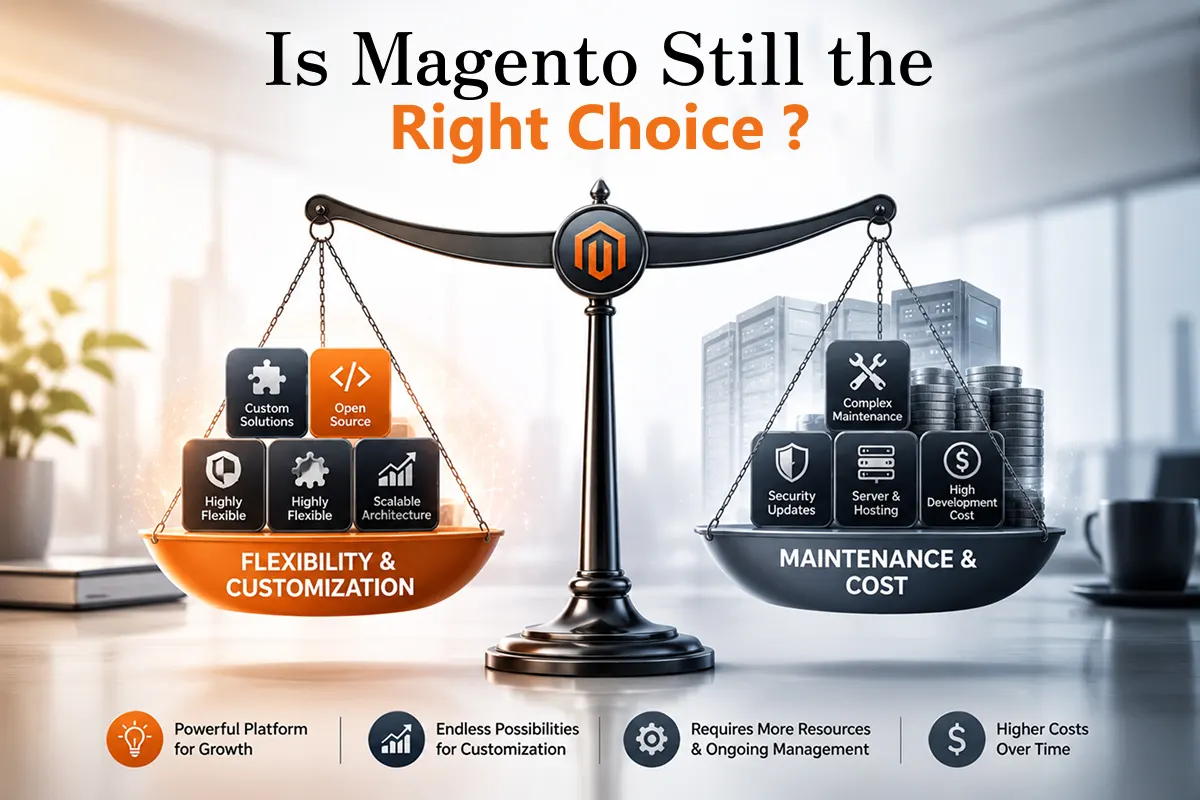
Magento (Adobe Commerce) remains a powerful platform for enterprises with complex requirements and dedicated development resources. However, for many growing eCommerce brands, Shopify offers lower maintenance costs, faster deployment, built-in security, and a simpler management experience. The right choice depends on your business goals, budget, technical requirements, and long-term growth strategy.
The Complete Decision Guide for Growing eCommerce Businesses
Table of Contents
- Why Are So Many Businesses Reconsidering Magento in 2026?
- Is Magento Still a Good eCommerce Platform?
- Why Thousands of Businesses Are Switching to Shopify
- Magento vs Shopify: Side-by-Side Comparison
- Questions Every Store Owner Should Ask Before Migrating
- When Should You Stay on Magento?
- When Does Shopify Make More Sense?
- Magento to Shopify Migration Cost
- Migration Process
- Frequently Asked Questions
- Final Recommendation
Are You Asking Yourself These Questions?
If you’re reading this guide, there’s a good chance one or more of these questions has crossed your mind:
- Is Magento becoming too expensive to maintain?
- Are we spending more on developers than on business growth?
- Is Shopify really easier to manage?
- Will migrating affect my Google rankings?
- Can I move without losing customer or order data?
- Is now the right time to migrate?
- How much will the migration actually cost?
You’re not alone.
These are the exact questions thousands of online store owners ask every year—and they often lead to one important decision:
Should I continue investing in Magento, or is it time to switch to Shopify?
This guide answers those questions with practical insights so you can make a confident, informed decision.

Why Are So Many Businesses Reconsidering Magento in 2026?
Magento has been one of the most flexible eCommerce platforms for years. Businesses chose it because it allowed almost unlimited customization.
But the eCommerce landscape has changed.
Today’s online stores need to launch features quickly, scale internationally, optimize for mobile, and provide fast shopping experiences. Many merchants now prefer platforms that reduce operational complexity.
Common challenges Magento merchants mention include:
- Rising development costs
- Regular maintenance and security updates
- Hosting and infrastructure management
- Dependence on technical teams
- Longer development cycles
- Complex upgrades
- Performance optimization work
- Third-party extension management
None of these are necessarily flaws—they’re trade-offs. Magento offers tremendous flexibility, but that flexibility often comes with higher ownership costs.
For some businesses, that’s a worthwhile investment. For others, it’s a sign that a different platform may better fit their current goals.
Not sure if your Magento store is still the right fit?
📲 Chat with our migration specialists for a free store assessment.
Is Magento Still Worth It in 2026?
The answer depends on your business—not just the platform.
Magento can still be an excellent choice if you need:
- Highly customized workflows
- Complex B2B functionality
- Large product catalogs
- Multiple storefronts with advanced control
- Deep ERP or CRM integrations
- Extensive customization beyond standard commerce features
However, it also requires:
- Ongoing development support
- Hosting management
- Performance tuning
- Security patching
- Upgrade planning
- Extension compatibility checks
If your business already has the technical resources and those capabilities are essential, Magento can continue to deliver value.
If your priorities have shifted toward simplicity, speed, and predictable costs, it may be time to evaluate alternatives.
Why Are More Businesses Choosing Shopify?
Shopify has evolved from a platform for small businesses into one trusted by global brands and enterprise retailers.
Instead of asking businesses to manage infrastructure, Shopify handles hosting, security, and updates so merchants can focus on growth.
Many businesses appreciate Shopify for:
Simpler Store Management
The admin interface is designed for everyday business users, making it easier to manage products, inventory, promotions, and orders.
Predictable Costs
Rather than budgeting separately for hosting, maintenance, and frequent development work, Shopify offers a more predictable pricing structure.
Faster Time to Market
Launching new products, promotions, or storefront updates generally requires less technical effort.
Built-In Security
SSL certificates, PCI compliance, and platform updates are managed by Shopify, reducing operational overhead.
Extensive App Ecosystem
Thousands of apps support marketing, shipping, subscriptions, inventory, reviews, loyalty programs, and automation.
Reliable Performance
With managed infrastructure and a global CDN, Shopify delivers strong performance without requiring merchants to manage servers.
Wondering whether Shopify is the right fit for your business model?
📲 Connect with our Shopify experts for personalized guidance.
Magento vs Shopify: A Practical Comparison
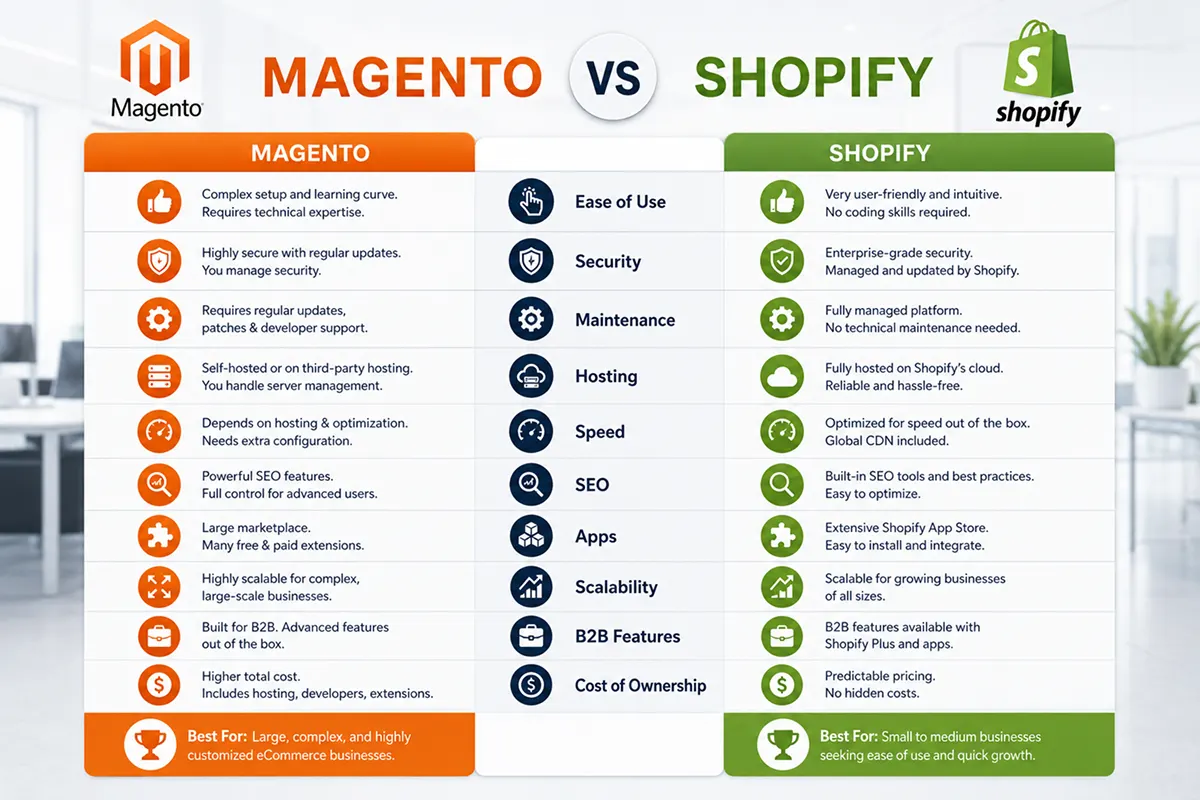
| Feature | Magento | Shopify |
| Hosting | Self-managed | Fully managed |
| Security | Merchant responsibility | Managed by Shopify |
| Platform Updates | Manual planning | Automatic |
| Store Management | Technical | User-friendly |
| Performance | Depends on infrastructure | Optimized by default |
| Maintenance | Ongoing | Minimal |
| App Ecosystem | Extensions | Shopify App Store |
| Scalability | Excellent | Excellent |
| International Selling | Strong | Strong with Shopify Markets |
| Best For | Complex custom builds | Fast-growing online businesses |
Neither platform is universally better. The best platform is the one that aligns with your business strategy, available resources, and growth plans
Questions Every Store Owner Should Ask Before Migrating
Before making a platform change, take time to evaluate your business.
Ask yourself:
- Are maintenance costs affecting profitability?
- Does your team rely heavily on developers for routine changes?
- Are upgrades becoming difficult or expensive?
- Is website performance meeting customer expectations?
- Are you planning international expansion?
- Do you need faster deployment of new features?
- Is your current platform supporting your long-term goals?
The answers to these questions often make the right direction much clearer.
When Should You Stay on Magento?
Staying on Magento may make sense if:
- Your store depends on highly specialized workflows.
- You have significant investment in custom development.
- Your team has dedicated Magento expertise.
- You require functionality that would be difficult to recreate elsewhere.
- Your current store performs well and meets business objectives.
In these situations, continuing with Magento—or upgrading to the latest version—may provide the best return on investment.
When Does Shopify Make More Sense?
Shopify is worth considering if you want to:
- Reduce maintenance overhead.
- Lower long-term operating costs.
- Simplify day-to-day store management.
- Improve speed and reliability.
- Launch marketing campaigns faster.
- Expand internationally using built-in commerce tools.
- Focus more on business growth than technical maintenance.
For many growing brands, these operational benefits become increasingly valuable over time.
If you answer “Yes” to most of the following questions, exploring a Magento-to-Shopify migration could be worthwhile:
Decision Checklist
- Maintenance costs continue to rise.
- Routine updates require developer involvement.
- Your team wants a simpler admin experience.
- You plan to scale into new markets.
- Performance improvements are a priority.
- Predictable monthly costs are important.
- You want less infrastructure management.
Free Migration Assessment
Every business has different priorities.
Before making a decision, it’s helpful to review:
- Current store architecture
- Custom functionality
- Third-party integrations
- Product catalog size
- SEO considerations
- Customer and order data
- Growth objectives
A professional migration assessment can identify potential risks, estimate costs, and recommend the best migration approach.
Ready to explore your options?
✔ Magento Store Audit
✔ Shopify Migration Roadmap
✔ SEO Impact Analysis
✔ Cost & Timeline Estimate
✔ No-Obligation Consultation
How Much Does Magento to Shopify Migration Cost in 2026?
It depends on your store’s complexity, product catalog, integrations, design requirements, and custom functionality.
Unlike moving a simple website, an eCommerce migration involves products, customers, order history, SEO, payment gateways, shipping methods, apps, and often years of business data.
A professional migration is not just about copying information—it’s about ensuring your new Shopify store performs better than your existing Magento store.
Typical Magento to Shopify Migration Costs
| Store Size | Products | Estimated Cost |
| Small Business | Up to 500 | $800 – $2,000 |
| Growing Store | 500–5,000 | $2,000 – $6,000 |
| Large Store | 5,000–20,000 | $6,000 – $15,000 |
| Enterprise | 20,000+ | $15,000 – $50,000+ |
Note: These are general estimates. The final cost depends on your specific requirements, custom features, and integrations.
What Influences Migration Cost?
Every migration project is unique. Some stores require only a straightforward data transfer, while others involve rebuilding complex workflows and custom functionality.
Common factors that affect pricing include:
Product Catalog Size
- Number of products
- Product variants
- Images
- Categories
- Product attributes
- Digital downloads
Customer Data
Migration can include:
- Customer accounts
- Addresses
- Wishlists (where supported)
- Customer groups
- Purchase history
Order History
Many businesses choose to migrate:
- Last 12 months
- Last 3 years
- Complete order history
The larger the dataset, the more planning and validation required.
Theme Design
Will you use:
- A premium Shopify theme?
- A fully custom design?
- A redesign during migration?
A custom Shopify storefront increases development time but provides a tailored user experience.
Third-Party Integrations
Your Magento store may connect with:
- ERP systems
- CRM software
- Accounting tools
- Shipping providers
- Marketing platforms
- Inventory management
- Marketplaces
SEO Preservation
A proper SEO migration typically includes:
- URL mapping
- 301 redirects
- Meta title migration
- Meta description migration
- Canonical tags
- XML sitemap
- Structured data
- Image optimization
- Google Search Console updates
Want a Personalized Migration Quote?
Every business is different.
Get a FREE Magento Store Assessment including:
- Cost Estimate
- Migration Timeline
- SEO Risk Analysis
- Shopify Recommendations
Each integration needs to be reviewed and recreated or replaced within Shopify.
Maintaining your search visibility is one of the most important parts of migration.
Skipping these steps can result in unnecessary ranking and traffic losses.
What Data Can Be Migrated from Magento to Shopify?
One of the biggest concerns business owners have is:
“Will I lose my data?”
The good news is that a professional migration can transfer most of your essential store data safely.
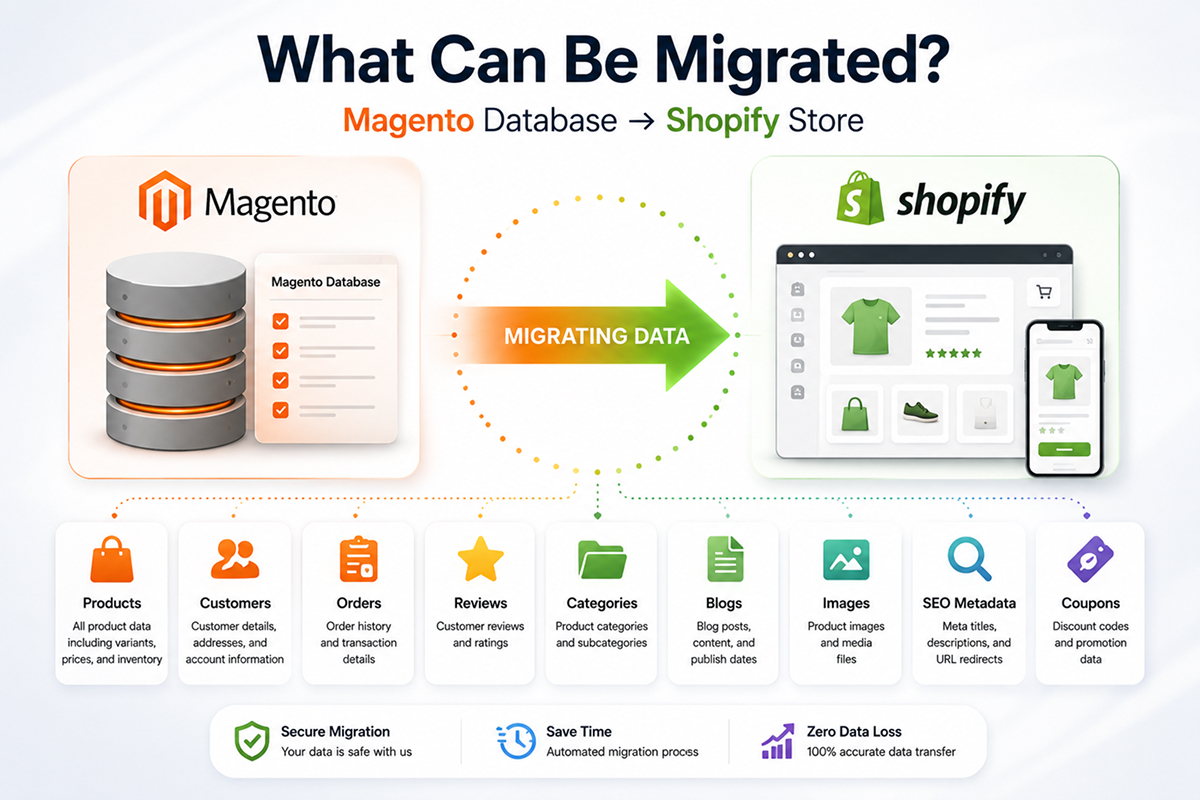
Products
Migration typically includes:
- Product names
- Descriptions
- SKUs
- Prices
- Sale prices
- Images
- Variants
- Inventory
- Collections
- Tags
- Product status
Customers
Customer information can include:
- Names
- Email addresses
- Billing details
- Shipping addresses
- Customer groups
- Purchase history
Orders
Depending on the project, historical order data can also be migrated, helping maintain reporting and customer service continuity.
Content
You can also migrate:
- CMS pages
- Blog articles
- FAQs
- Policies
- Navigation menus
- Collections
SEO Data
An experienced migration team will preserve as much SEO value as possible by migrating:
- Meta titles
- Meta descriptions
- Image ALT text
- URL structures (with redirects where needed)
- Structured data
- Canonical information
Magento to Shopify Migration Process
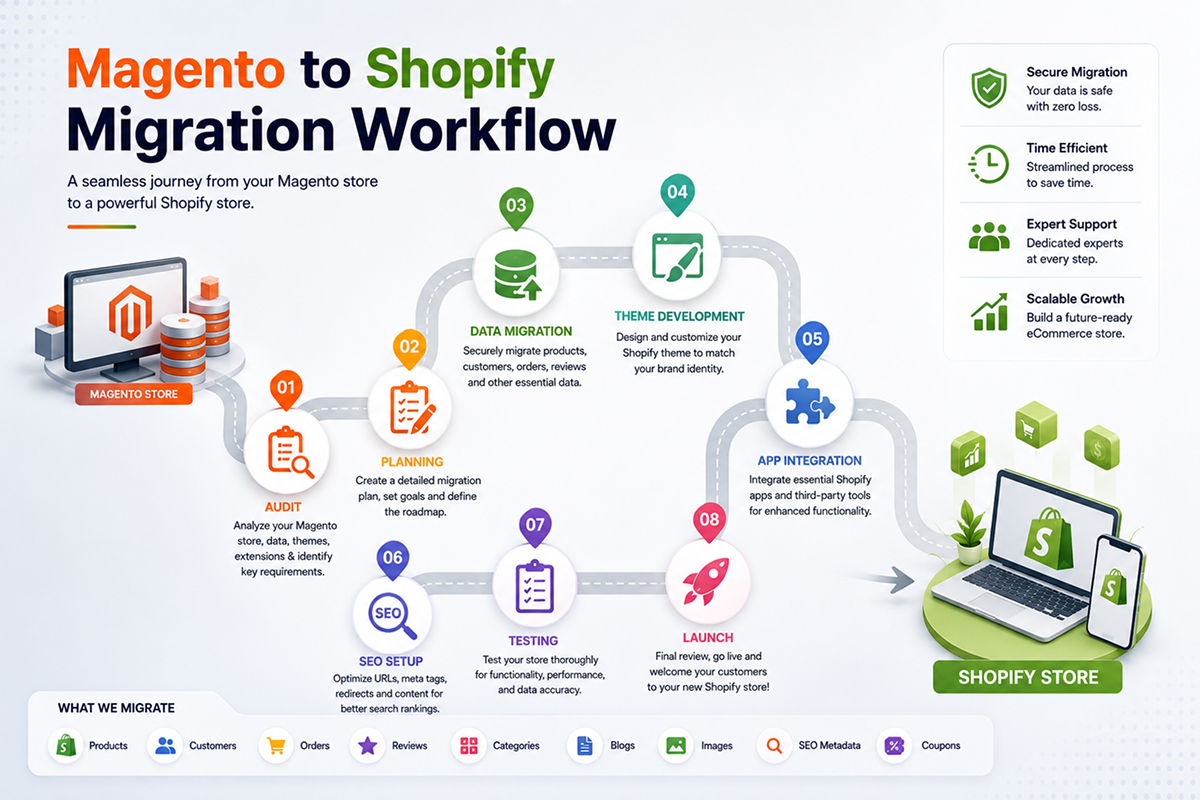
A successful migration follows a structured approach.
Step 1: Store Audit
Review:
- Store size
- Integrations
- Extensions
- Theme
- SEO
- Performance
- Custom functionality
Step 2: Migration Planning
Define:
- Timeline
- Data mapping
- Redirect strategy
- Testing plan
- Go-live checklist
Step 3: Full Backup
Create a secure backup of your Magento store before any migration work begins.
Step 4: Data Migration
Transfer:
- Products
- Customers
- Orders
- Images
- Content
Step 5: Shopify Store Setup
Configure:
- Shopify settings
- Payment gateways
- Shipping methods
- Taxes
- Markets
- Languages
Step 6: Theme Development
Recreate or redesign your storefront to match your branding and improve user experience.
Step 7: App & Integration Setup
Replace Magento extensions with Shopify apps or custom-built solutions where necessary.
Step 8: SEO Migration
Implement:
- URL redirects
- Metadata
- Sitemap
- Structured data
- Canonical tags
- txt review
Step 9: Quality Assurance
Verify:
- Products
- Checkout
- Forms
- Search
- Navigation
- Mobile responsiveness
- Speed
- Integrations
Step 10: Launch
Complete a final data sync, update DNS if required, and make the Shopify store live with minimal disruption.
Will My SEO Rankings Be Affected?
This is one of the most common concerns – and understandably so.
However, with a structured SEO migration plan, many businesses maintain or recover their search visibility effectively.
A poorly executed migration can lead to:
- Broken links
- Missing redirects
- Duplicate content
- Lost metadata
- Reduced organic traffic
Key SEO tasks include:
- 301 Redirect Mapping
- URL Structure Review
- Meta Data Migration
- Internal Link Updates
- XML Sitemap Submission
- Structured Data Validation
- Google Search Console Monitoring
- Core Web Vitals Optimization
SEO performance should be monitored closely after launch so any issues can be addressed promptly.
Protect Your SEO During Migration
Our migration process includes a dedicated SEO review to help preserve your organic visibility.
How Long Does Magento to Shopify Migration Take?
The timeline depends on the size and complexity of your store.
| Store Type | Estimated Timeline |
| Small Store | 3–7 Days |
| Medium Store | 2–4 Weeks |
| Large Store | 4–8 Weeks |
| Enterprise | 2–4 Months |
Factors influencing the timeline include:
- Product count
- Theme customization
- App integrations
- Custom development
- SEO requirements
- Testing and validation
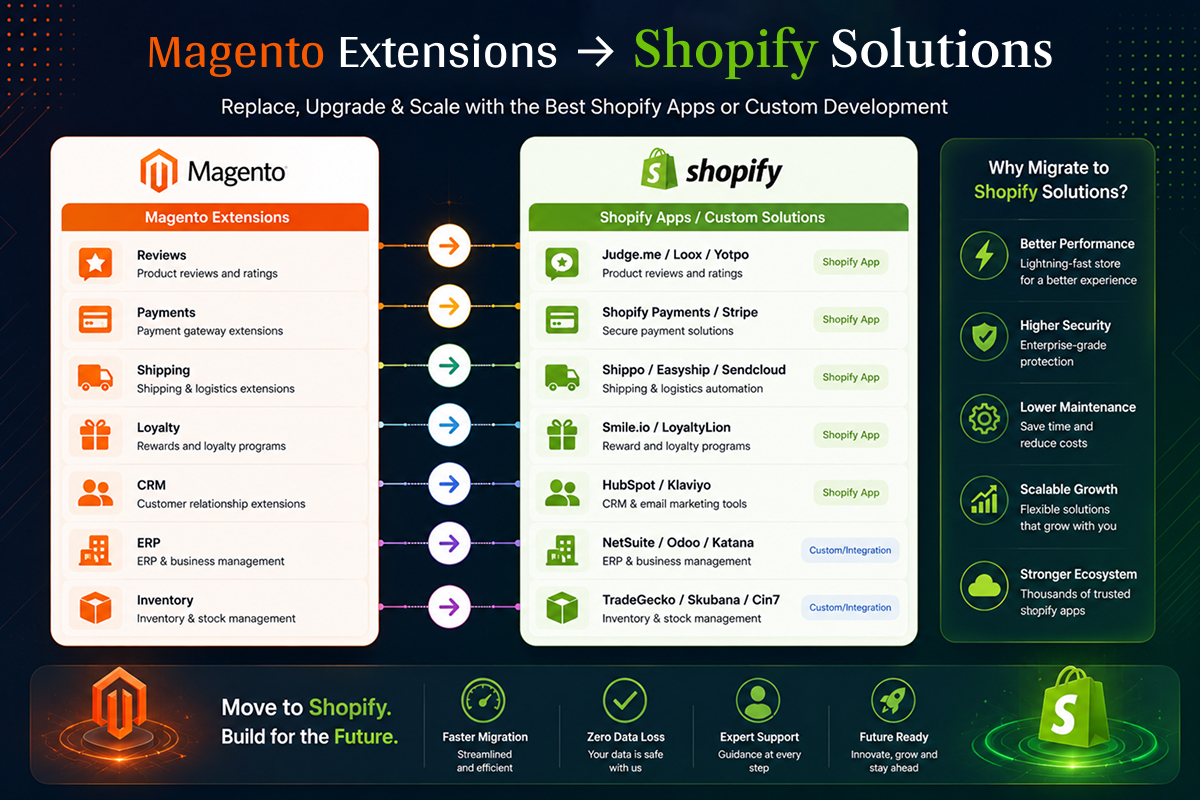
What Happens to Magento Extensions?
Magento extensions cannot be transferred directly to Shopify because the platforms use different architectures.
Instead, equivalent functionality is achieved through:
- Shopify Apps
- Shopify Functions
- Shopify Flow
- Custom App Development
- Shopify APIs
Before migration, each extension should be reviewed to determine whether it should be replaced, rebuilt, or removed.
Common Migration Mistakes to Avoid
Many migration issues can be prevented with proper planning.
Common mistakes include:
- Launching without redirect testing
- Ignoring SEO metadata
- Skipping a full data backup
- Choosing apps without evaluating functionality
- Failing to test checkout and payment flows
- Migrating unnecessary or outdated data
- Underestimating the importance of user acceptance testing
Working with an experienced migration partner can significantly reduce these risks.
Ready to Move from Magento to Shopify?
Whether you’re managing a growing online store or a large enterprise business, careful planning is the key to a successful migration.
A structured migration strategy helps ensure:
- Secure data transfer
- Preserved SEO
- Reliable performance
- Minimal downtime
- A better experience for both your team and your customers
Free Magento to Shopify Migration Assessment
✔ Store Audit
✔ Cost Estimate
✔ Migration Roadmap
✔ SEO Review
✔ Timeline Planning
✔ Shopify Recommendations
Frequently Asked Questions
1. Why Should I Migrate from Magento to Shopify?
This is one of the most common questions we hear from merchants considering a platform change.
Magento is a powerful platform, especially for businesses with highly customized requirements. However, as your business grows, maintaining Magento can become more time-consuming and expensive. Many merchants eventually find themselves spending more on hosting, security updates, extension compatibility, and developer support than on growing their business.
Shopify offers a different approach. It provides a fully managed commerce platform where hosting, security, software updates, and infrastructure are handled for you. This allows your team to focus on marketing, customer experience, and sales rather than ongoing technical maintenance.
Businesses commonly migrate to Shopify to:
- Reduce maintenance and infrastructure costs
- Simplify day-to-day store management
- Improve website speed and reliability
- Launch products and promotions more quickly
- Take advantage of Shopify’s large app ecosystem
- Scale internationally using Shopify Markets
- Deliver a smoother checkout experience
If your current Magento store requires constant technical attention, migrating to Shopify could reduce operational complexity and free up resources for business growth.
💬 Need help deciding?
Every business has different requirements. Let our experts review your current Magento store and recommend whether migration is the right choice.
2. Will I Lose Any Data During the Migration?
Data security is one of the biggest concerns during any eCommerce migration.
A professionally planned migration is designed to preserve your important business data. Before any work begins, a complete backup of your Magento store should be created. This provides an additional layer of protection throughout the migration process.
Depending on your store and requirements, the following data can typically be migrated:
- Products and variants
- Categories or collections
- Product images
- Customer accounts
- Billing and shipping addresses
- Order history
- CMS pages
- Blog content
- SEO metadata
- Navigation menus
- Discount rules (where applicable)
After the migration, each data set should be reviewed and validated to ensure accuracy before the new Shopify store goes live.
💬 Want to know exactly what can be migrated?
Request a free migration assessment, and we’ll review your current Magento store.
3. How Long Does Magento to Shopify Migration Take?
The timeline depends on the size and complexity of your store.
A small store with a few hundred products can often be migrated within days, while enterprise stores with thousands of products, multiple integrations, and custom functionality require more planning and testing.
Typical timelines are:
| Store Type | Estimated Timeline |
| Small Store | 3–7 days |
| Medium Store | 2–4 weeks |
| Large Store | 4–8 weeks |
| Enterprise Store | 2–4 months |
Factors that influence the timeline include:
- Number of products and variants
- Customer and order data
- Theme customization
- Third-party integrations
- SEO migration
- Quality assurance and user acceptance testing
Rushing a migration can introduce unnecessary risks. A structured approach helps ensure a smoother launch.
💬 Need a migration timeline for your store?
4. Will My SEO Rankings Be Affected After Migration?
SEO is often one of the biggest concerns when moving from Magento to Shopify.
A migration changes the underlying platform, and in many cases, URLs or technical elements may also change. Without proper planning, this can affect search visibility.
A well-executed SEO migration typically includes:
- 301 redirects from old URLs to new URLs
- Migration of meta titles and descriptions
- Structured data validation
- Canonical tag implementation
- XML sitemap generation
- Internal link review
- Google Search Console monitoring
- Ongoing post-launch SEO checks
While short-term fluctuations can occur, careful planning helps preserve your search performance and minimizes disruption.
💬 Want an SEO-safe migration?
5. What Happens to My Magento Extensions and Custom Functionality?
Magento extensions cannot be transferred directly because Shopify uses a different architecture.
Before migration, each extension should be evaluated to determine the best replacement. Depending on the functionality, it may be replaced with:
- Shopify Apps
- Shopify Functions
- Shopify Flow automations
- Custom Shopify development
- Private or custom apps
- API integrations
The goal is not simply to replace every extension, but to ensure the new Shopify store supports your business processes effectively.
💬 Not sure which extensions can be replaced?
6. Will My Payment Gateways and Shipping Settings Be Migrated?
Payment gateways and shipping methods are generally recreated rather than transferred directly.
During setup, your Shopify store can be configured with supported payment providers, shipping zones, tax settings, and delivery methods that match your business requirements.
Each payment and shipping workflow should be tested thoroughly before launch.
💬 Need help configuring payments and shipping?
7. What If I Need Custom Features After Migration?
One common misconception is that Shopify only supports basic stores.
In reality, Shopify can be extended with:
- Custom apps
- Shopify Functions
- API integrations
- B2B features (Shopify Plus)
- Subscription systems
- Product configurators
- ERP and CRM integrations
- Inventory automation
If your business relies on specialized workflows, these can often be recreated using Shopify’s development framework.
💬 Need custom Shopify functionality?
8. Will My Magento Store Stay Online During the Migration?
Yes.
A professional migration is typically completed using a staging Shopify store while your Magento store continues serving customers.
The process generally includes:
- Building the Shopify store in the background
- Migrating and validating data
- Testing functionality
- Performing a final data sync
- Launching the Shopify store
This approach minimizes disruption and helps avoid unnecessary downtime.
💬 Planning a zero-downtime migration?
9. How Much Does Magento to Shopify Migration Cost?
Migration costs vary depending on:
- Store size
- Product catalog
- Theme requirements
- SEO migration
- Integrations
- Custom functionality
Typical project costs include:
| Store Size | Estimated Cost |
| Small | $800–$2,000 |
| Medium | $2,000–$6,000 |
| Large | $6,000–$15,000 |
| Enterprise | $15,000–$50,000+ |
A detailed audit is the best way to receive an accurate estimate.
💬 Want a personalized migration quote?
Why Choose MagentoBrain for Your Magento to Shopify Migration?
Choosing the right migration partner is just as important as choosing the right platform.
At MagentoBrain, we focus on delivering migrations that prioritize performance, SEO, and long-term scalability.
Our migration services include:
- Complete store migration
- Product, customer, and order migration
- Shopify theme development
- SEO migration with redirect planning
- Shopify app setup and integration
- Custom functionality development
- Shopify Plus migration
- Performance optimization
- Quality assurance and launch support
- Post-migration maintenance
Whether you’re migrating a small online store or a complex enterprise solution, our team works to ensure a smooth and well-planned transition.
Final Insights
There is no single platform that’s perfect for every business.
Magento remains an excellent solution for organizations that require extensive customization and have the technical resources to manage it.
Shopify, on the other hand, has become a compelling choice for businesses that want to reduce maintenance, simplify operations, and focus on growth.
The best decision depends on your goals, your budget, your technical requirements, and your long-term strategy.
If you’re still unsure, don’t make the decision based on assumptions. Evaluate your current store, understand the costs and benefits, and choose the platform that best supports your future growth.
Ready to Find Out if Shopify Is the Right Next Step?
Every successful migration starts with a clear plan.
Our team can help you evaluate:
- Your current Magento store
- Migration complexity
- Expected costs
- SEO considerations
- Timeline
- Custom functionality
- Shopify app recommendations
- Potential risks and opportunities
Free Magento to Shopify Migration Assessment Includes:
✅ Store Audit
✅ Migration Strategy
✅ SEO Review
✅ Cost Estimate
✅ Timeline Planning
✅ Shopify Recommendations
✅ No-Obligation Consultation


