

From technical SEO and Core Web Vitals to international SEO and Shopify Markets, this complete guide shows enterprise brands how to improve rankings, attract qualified traffic, and grow revenue through organic search.
Imagine investing thousands of dollars every month in your Shopify Plus store.
You’ve chosen one of the world’s leading enterprise eCommerce platforms. Your website looks modern, your products are well-designed, your checkout experience is smooth, and your marketing team is actively running campaigns.
Yet something doesn’t feel right.
Your competitors continue appearing above you in Google search results.
They seem to attract more organic visitors, rank for more commercial keywords, and generate consistent sales without relying entirely on paid advertising.
Meanwhile, your business keeps increasing its advertising budget just to maintain the same level of traffic.
If this situation sounds familiar, you’re not alone.
Many growing eCommerce brands assume that upgrading to Shopify Plus automatically improves SEO. In reality, Shopify Plus provides a strong technical foundation, but it doesn’t guarantee higher rankings on its own.
Organic growth comes from a combination of technical excellence, high-quality content, strong site architecture, optimized product and collection pages, fast loading times, structured data, and a strategy that aligns with how modern search engines evaluate websites.
For businesses selling internationally, the challenge becomes even greater. Multiple markets, multiple languages, localized content, regional search intent, and country-specific optimization all influence how your store performs in search.
That’s why Shopify Plus SEO is much more than adding keywords to product pages. It’s an ongoing process that connects technical optimization with user experience, content strategy, and business growth.
In this guide, we’ll explore every major aspect of Shopify Plus SEO, including:
- What makes Shopify Plus SEO different from standard Shopify SEO
- Technical SEO best practices for enterprise stores
- Product and collection page optimization
- Shopify International SEO strategies
- Core Web Vitals improvements
- Structured data implementation
- Common technical SEO issues
- SEO audit checklists
- How long SEO takes to deliver results
- Whether you should manage SEO in-house or work with a Shopify Plus SEO expert
Whether you’re launching a new Shopify Plus store or looking to improve the performance of an established enterprise business, this guide is designed to help you make informed decisions and build a sustainable organic growth strategy.
Free Shopify Plus SEO Audit
Before investing more in paid advertising, understand what’s limiting your organic growth. Our team can review your Shopify Plus store, identify technical SEO issues, evaluate Core Web Vitals, and provide practical recommendations tailored to your business goals.
Why Shopify Plus SEO Matters More Than Ever in 2026
Search has changed dramatically over the last few years.
Customers no longer discover products through a single Google search and immediately make a purchase. They compare brands, use AI-powered search experiences, browse social platforms, read reviews, and expect fast, personalized shopping experiences across every device.
For Shopify Plus merchants, this shift means SEO is no longer just about rankings—it’s about creating a technically sound, content-rich, and user-friendly shopping experience that search engines and customers both trust.
Today, Google’s ranking systems evaluate far more than keywords. They consider page experience, Core Web Vitals, structured data, helpful content, internal linking, crawl efficiency, mobile usability, and overall website quality. AI-powered search experiences also prioritize websites that provide comprehensive, authoritative answers and demonstrate real expertise.
This is especially important for enterprise Shopify stores. Large product catalogs, multiple collections, international storefronts, and thousands of URLs introduce challenges that smaller websites rarely encounter.
Without a structured SEO strategy, even well-designed Shopify Plus stores can experience:
- Declining organic visibility
- Duplicate content across collections
- Slow-loading product pages
- Poor Core Web Vitals scores
- Weak internal linking
- Crawl budget inefficiencies
- International indexing issues
- Reduced visibility for high-intent commercial keywords
On the other hand, businesses that invest in Shopify Plus SEO create long-term assets. Every optimized product page, buying guide, collection page, and technical improvement contributes to sustainable traffic growth that doesn’t disappear the moment an advertising campaign ends.
Think of SEO as building digital real estate. Paid advertising rents attention. Strong organic visibility earns it over time.
Perfect. Now we move into the core educational section. This is where we start demonstrating expertise while keeping the content easy for business owners—not just SEO professionals—to understand.
What Is Shopify Plus SEO, and How Is It Different from Regular Shopify SEO?
One of the biggest misconceptions in eCommerce is that Shopify Plus automatically delivers better SEO because it’s an enterprise platform.
The reality is more nuanced.
Shopify Plus provides a stronger foundation for scaling large online stores, but it doesn’t automatically improve your search rankings. Instead, it gives businesses access to advanced capabilities that make implementing an effective SEO strategy easier—especially for stores with large catalogs, multiple international markets, and complex operational requirements.
Think of it this way:
Buying a Formula 1 race car doesn’t make someone a Formula 1 champion.
The car has incredible potential, but success still depends on the driver, the strategy, the engineering, and continuous optimization.
Shopify Plus works the same way.
The platform offers the tools, infrastructure, and scalability, but your rankings depend on how effectively those tools are used.
Understanding Shopify SEO
Every Shopify store—whether it’s on the Basic, Grow, Advanced, or Plus plan—shares many of the same SEO fundamentals.
These include:
- Optimizing product pages with relevant keywords
- Creating descriptive collection pages
- Writing unique meta titles and descriptions
- Building a logical internal linking structure
- Optimizing images and ALT text
- Improving page speed
- Creating valuable blog content
- Earning high-quality backlinks
- Implementing structured data
- Monitoring performance in Google Search Console
These practices are essential for every Shopify website, regardless of the subscription plan.
So What Makes Shopify Plus SEO Different?
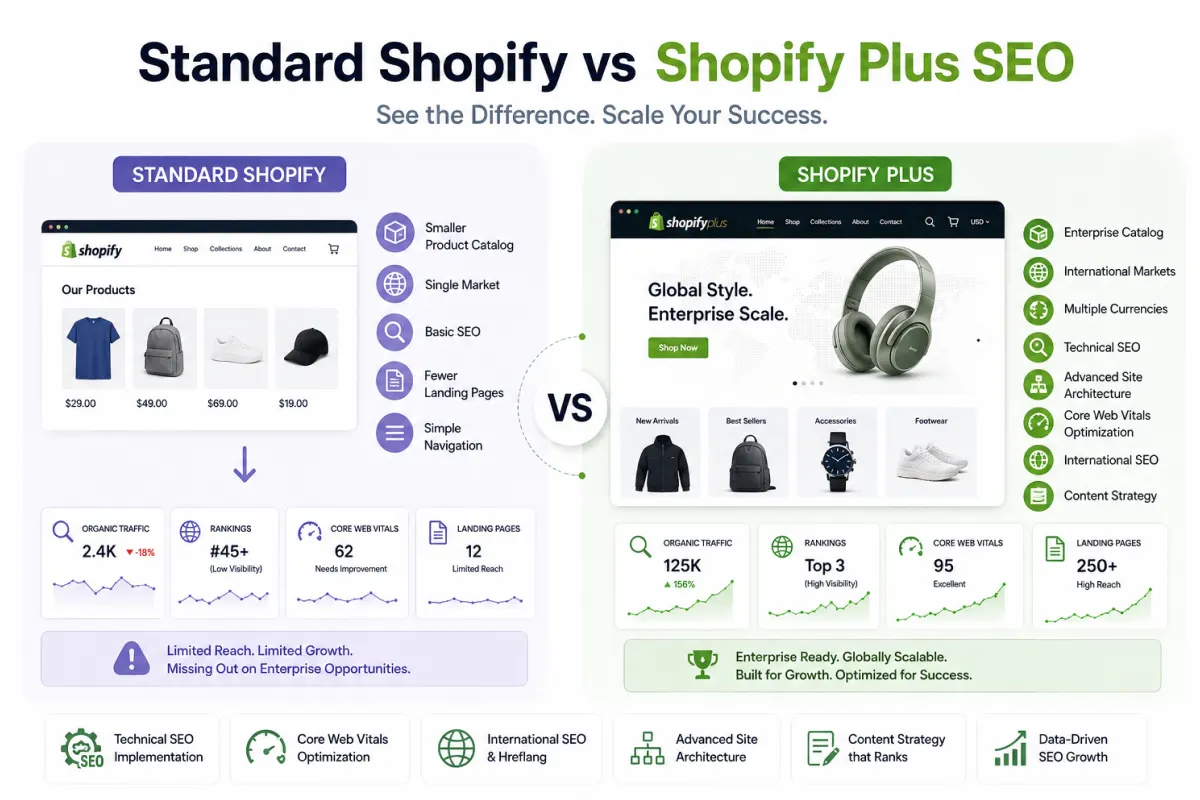
The difference isn’t simply in the platform—it’s in the scale and complexity of the business using it.
Most Shopify Plus merchants manage significantly larger operations than standard Shopify stores.
For example, a typical Shopify store may have:
- 300 products
- One country
- One language
- One warehouse
- One marketing team
A Shopify Plus merchant may operate:
- 50,000+ products
- Multiple international storefronts
- Multiple languages
- Multiple currencies
- Regional inventory
- Wholesale and B2B catalogs
- Custom checkout experiences
- ERP integrations
- PIM systems
- Marketing teams across different regions
Managing SEO across this environment requires a much more sophisticated strategy.
Why Enterprise SEO Requires a Different Approach
As an online store grows, SEO becomes more than optimizing individual pages.
It becomes about managing an entire digital ecosystem.
Consider an international fashion brand selling in:
- United States
- Canada
- United Kingdom
- Germany
- France
- Australia
- United Arab Emirates
Each market has different:
- Search behavior
- Languages
- Currency
- Seasonal trends
- Competition
- User expectations
This can lead to:
- Duplicate content
- Incorrect regional indexing
- Poor user experience
- Reduced visibility
- Lost organic traffic
Without a well-planned international SEO strategy, search engines may struggle to understand which version of your content should appear for users in different countries.
For enterprise brands, SEO is no longer just a marketing activity—it becomes a business growth strategy.
Expert Insight
Many businesses invest heavily in redesigning their Shopify Plus store but overlook SEO planning.
They launch a visually stunning website only to discover months later that organic traffic has declined because redirects, metadata, structured data, or internal links weren’t handled correctly.
The lesson is simple:
Design attracts visitors. SEO helps them find you in the first place.
Is Shopify Plus Better for SEO Than Standard Shopify?
This question appears frequently, and the honest answer is:
Not automatically—but it offers significant advantages for businesses that know how to use its capabilities.
Let’s compare.
| Feature | Standard Shopify | Shopify Plus |
| SEO Fundamentals | ✅ | ✅ |
| Custom Theme Optimization | Good | Excellent |
| International Expansion | Limited | Advanced with Shopify Markets |
| Large Catalog Management | Moderate | Excellent |
| Enterprise Scalability | Moderate | Excellent |
| Checkout Customization | Limited | Advanced |
| Automation | Basic | Shopify Flow & Functions |
| Multi-Store Management | Limited | Advanced |
| API Capacity | Standard | Higher Limits |
Notice something important:
The table doesn’t say Shopify Plus gives you “better rankings.”
Instead, it gives you more flexibility to build an SEO strategy that supports enterprise growth.
What Does This Mean for Your Business?
If you’re a growing D2C brand with 500 products and one target market, standard Shopify may be sufficient.
However, if your business is expanding internationally, managing multiple storefronts, or operating with large product catalogs, Shopify Plus provides the tools needed to scale SEO effectively.
The platform becomes an enabler—but the strategy still determines the results.
Why Many Shopify Plus Stores Still Struggle to Rank
One of the biggest surprises for new Shopify Plus merchants is that upgrading the platform doesn’t instantly increase organic traffic.
In fact, we often see enterprise stores with:
- Beautiful designs
- Premium themes
- Excellent products
- Strong advertising campaigns
…but disappointing organic performance.
Why?
Because SEO challenges usually come from implementation rather than the platform itself.
Common issues include:
Thin Product Content
Using manufacturer descriptions across thousands of products creates duplicate or low-value content that doesn’t differentiate your store.
Weak Collection Pages
Many collection pages list products without providing helpful introductory content, buying guidance, or keyword-focused copy.
Poor Internal Linking
Large catalogs often leave valuable pages buried several clicks deep, making them harder for search engines to discover and understand.
Duplicate URLs
Filters, tags, pagination, and variant URLs can create unnecessary duplication if not managed carefully.
Missing Structured Data
Without proper schema markup, search engines have less context about your products, reviews, pricing, and availability.
Slow Core Web Vitals
Large images, third-party scripts, and poorly optimized themes can negatively impact user experience and search performance.
International SEO Errors
Incorrect hreflang implementation, duplicate localized content, or poor country targeting can reduce visibility across global markets.
Quick Self-Assessment
Ask yourself these questions:
- Does your Shopify Plus store have more than 5,000 products?
- Are you selling in multiple countries?
- Do your collection pages contain unique content?
- Are Core Web Vitals passing on mobile?
- Have you implemented structured data correctly?
- Is every important page reachable within three clicks?
- Do you have a documented international SEO strategy?
If you answered “No” to several of these questions, there are likely opportunities to strengthen your organic search performance.
Free Shopify Plus SEO Audit
Before investing further in paid advertising, it’s worth understanding how your store performs from an SEO perspective.
Our Shopify Plus SEO audit reviews:
✔ Technical SEO health
✔ Product and collection optimization
✔ Core Web Vitals
✔ Structured data
✔ Internal linking
✔ International SEO
✔ Crawlability and indexing
✔ Organic growth opportunities
Excellent. This is where your article becomes significantly more valuable than a typical agency blog. Rather than listing generic tips, we’ll explain why each practice matters, how to implement it, and what impact it can have on organic growth.
The Complete Shopify Plus SEO Framework: 25 Best Practices That Drive Long-Term Organic Growth
Successful Shopify Plus SEO isn’t about chasing Google’s latest algorithm update or stuffing pages with keywords. It’s about building a store that’s easy for search engines to understand and enjoyable for customers to use.
Enterprise brands that consistently grow organic traffic usually have one thing in common: they treat SEO as an ongoing business strategy, not a one-time project.
Instead of making random SEO changes, they improve every layer of their store—from technical performance and site architecture to content quality and user experience.
Let’s explore the framework that helps Shopify Plus stores compete for high-value search terms.
1. Build a Clear Site Architecture That Search Engines Can Understand
Imagine walking into a supermarket where products are placed randomly.
Milk is next to electronics.
Shoes are mixed with kitchen appliances.
There are no signs, no categories, and no logical paths.
Customers would quickly become frustrated.
Search engines feel the same way when a website has poor structure.
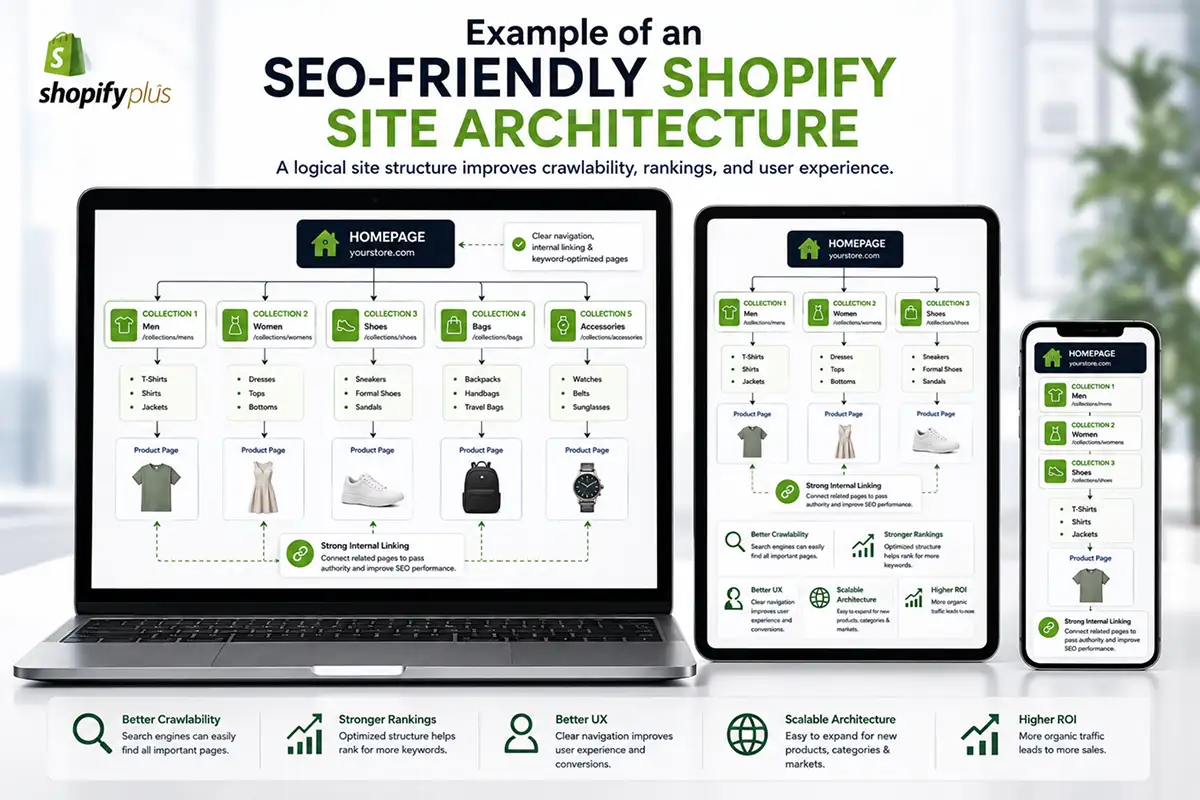
Your Shopify Plus store should guide both users and search engine crawlers naturally from broad categories to highly specific products.
A recommended structure looks like this:
Home
│
├── Men
│ ├── Running Shoes
│ ├── Casual Shoes
│ └── Boots
│
├── Women
│ ├── Sneakers
│ ├── Sandals
│ └── Heels
│
└── Accessories
This hierarchy makes it easier for Google to understand topical relationships between pages and distribute authority throughout your website.
Best Practices
- Keep important pages within three clicks of the homepage.
- Use descriptive category names.
- Avoid creating unnecessary nested collections.
- Maintain consistent navigation across desktop and mobile.
- Link related categories together where appropriate
Why It Matters
A well-organized structure improves:
- Crawl efficiency
- User experience
- Internal linking
- Keyword relevance
- Indexation of important pages
Expert Tip
Every new collection you create should support a broader category strategy rather than existing as an isolated page.
📲 Need Help Organizing a Large Shopify Plus Catalog?
A poorly structured store can make even great products difficult to discover. Our Shopify Plus SEO audit identifies navigation, collection, and internal linking opportunities that support long-term organic growth.
2. Optimize Product Pages for Search Intent, Not Just Keywords
Many Shopify merchants rely on supplier descriptions or generic product copy.
The problem?
Search engines have likely seen the same text across dozens—or even hundreds—of other websites.
Unique, helpful product content gives your store a better chance to stand out.
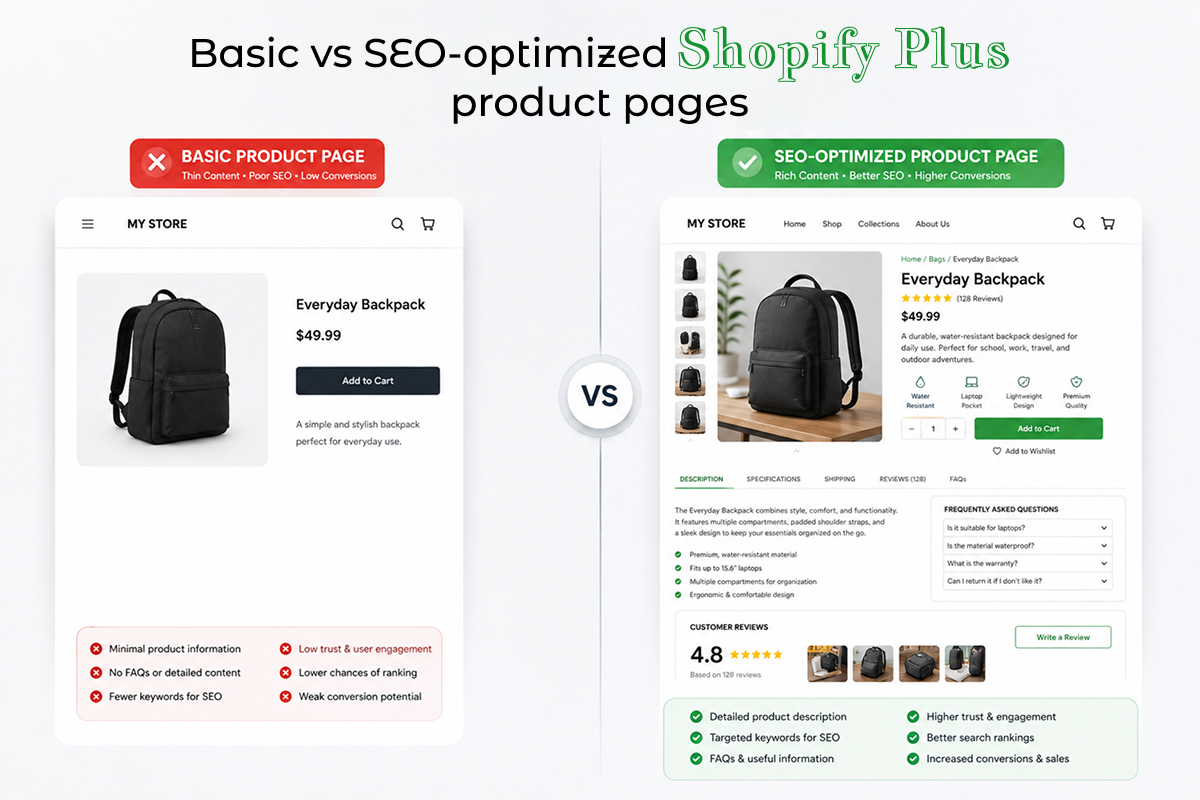
A strong product page should answer questions customers actually ask before making a purchase.
Include:
- What makes the product unique?
- Who is it designed for?
- Key benefits and features.
- Materials or ingredients.
- Sizing or compatibility information.
- Care instructions.
- Frequently asked questions.
- Related products.
- Customer reviews.
Product Page Checklist
✔ Unique title
✔ Compelling meta description
✔ Optimized H1
✔ Original product description
✔ Feature bullets
✔ Benefit-focused content
✔ Optimized images
✔ Descriptive ALT text
✔ Customer reviews
✔ Product schema
The goal isn’t simply to rank—it’s to help visitors feel confident enough to buy.
Example
Instead of:
Premium Leather Wallet
Write:
Handmade Premium Leather Wallet for Men – RFID Protection & Slim Design
The second title communicates more information and aligns better with what users search for.
📲 Want Better Product Rankings?
We help Shopify Plus merchants optimize product pages for search visibility, user experience, and conversions.
3. Transform Collection Pages into High-Value Landing Pages
Collection pages are often among the strongest SEO assets on a Shopify Plus store.
Yet many businesses leave them almost empty.
A collection page should do more than display products—it should educate visitors, answer buying questions, and reinforce topical relevance.
For example, instead of simply listing “Running Shoes,” explain who they’re for, key technologies, common use cases, and how to choose the right pair.
Include:
- An introductory paragraph explaining the collection.
- Buying tips.
- Product highlights.
- Internal links to related collections.
- Frequently asked questions.
- Featured products.
- Seasonal recommendations.
Collection SEO Checklist
✔ Keyword-focused heading
✔ Helpful introductory content
✔ Buying guide
✔ Internal links
✔ FAQs
✔ Optimized images
✔ Collection schema
Why It Matters
Rich collection pages improve:
- Keyword relevance
- Time on page
- Internal linking
- Crawl depth
- User engagement
📲 Strengthen Your Collection Pages
Our team helps create SEO-friendly collection pages that attract qualified traffic and support purchasing decisions.
4. Create a Content Strategy That Supports Every Stage of the Buying Journey
Many stores only publish product pages.
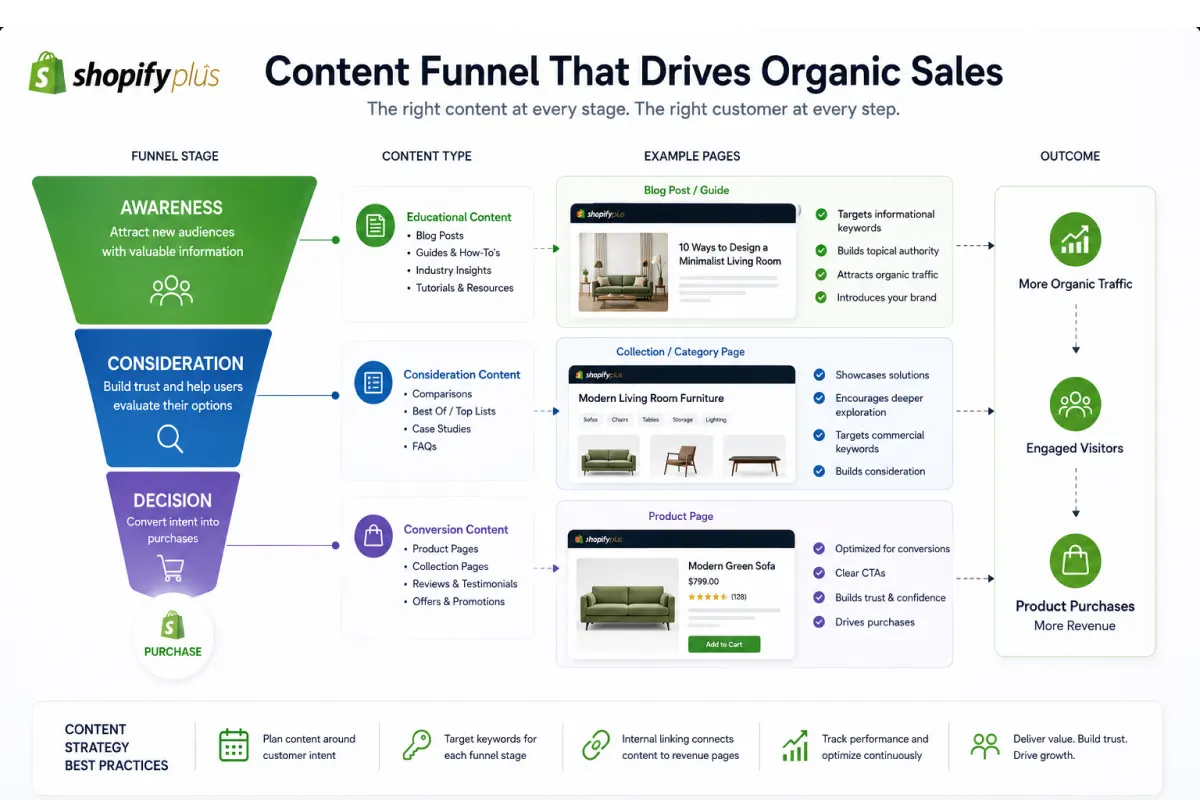
Successful Shopify Plus brands build an ecosystem of helpful content that answers customer questions before, during, and after the buying process.
Think beyond products.
Create resources such as:
- Buying guides.
- Product comparisons.
- Care and maintenance articles.
- Industry trends.
- Frequently asked questions.
- Seasonal shopping guides.
- Case studies.
- Expert insights.
Each piece of content can naturally link to relevant collections and products, strengthening topical authority while helping customers make informed decisions.
Example Content Funnel
“How to Choose the Right Running Shoes”
“Best Running Shoes for Marathon Training”
“Men’s Carbon Running Shoes Collection”
This approach aligns informational searches with commercial pages
📲 Build an SEO Content Strategy
We help Shopify Plus brands plan content that supports both rankings and revenue.
5. Strengthen Internal Linking Across Your Store
Internal links are often overlooked, yet they’re one of the most effective ways to help search engines understand your website.
Good internal linking:
- Connects related products.
- Reinforces topical relationships.
- Helps users discover more content.
- Distributes authority across important pages.
- Encourages longer browsing sessions.
Link naturally between:
- Blog articles
- Buying guides
- Collections
- Products
- Brand pages
- FAQs
Internal Linking Checklist
✔ Related collections
✔ Related products
✔ Blog to collection links
✔ Collection to buying guide links
✔ Contextual anchor text
✔ No orphan pages
Avoid linking solely for SEO. Every link should provide genuine value to the visitor.
Expert Tip
Review your most important pages regularly to ensure they’re receiving internal links from relevant, high-authority pages within your site.
📲 Improve Your Internal Linking Strategy
A thoughtful internal linking structure can improve crawlability, rankings, and user engagement across your Shopify Plus store.
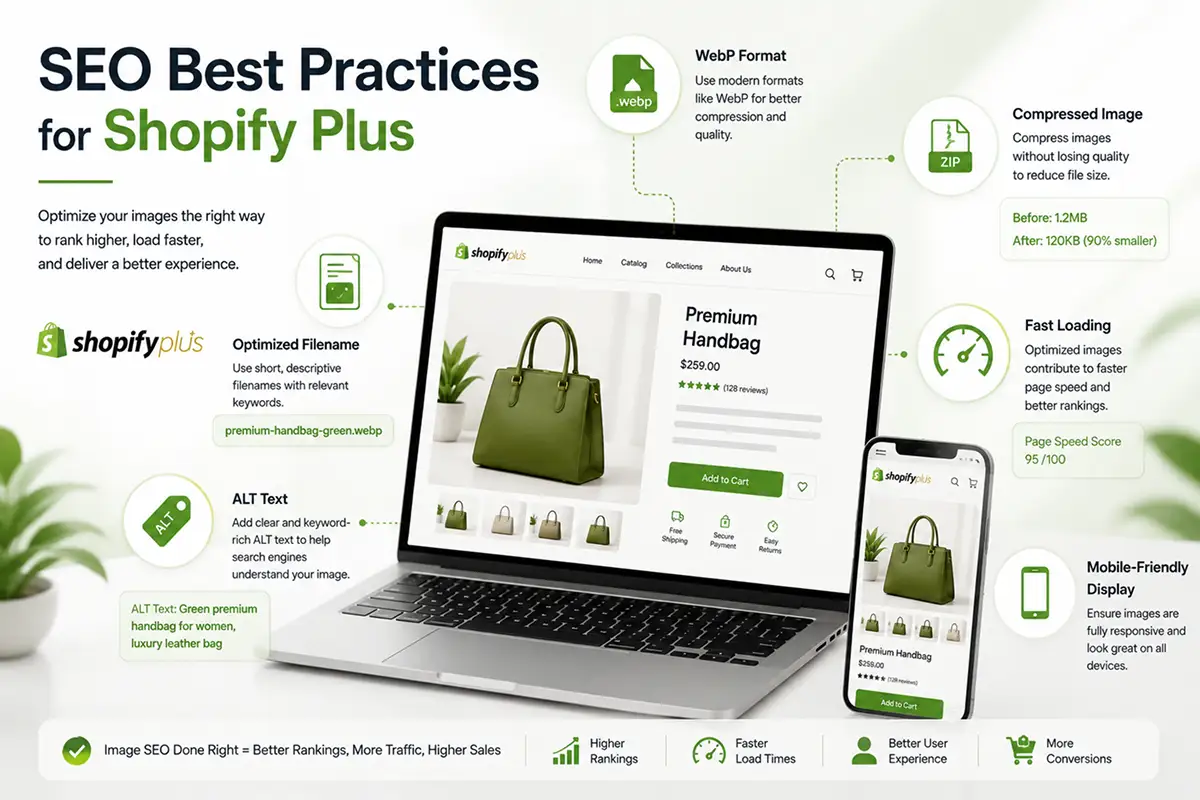
6. Optimize Images for Search Engines and Faster Page Speed
Images are one of the most important elements of an eCommerce store. They influence purchase decisions, improve user engagement, and can even generate additional traffic through Google Images.
However, large image libraries can also become one of the biggest reasons for poor Core Web Vitals and slow-loading pages.
Many Shopify Plus stores upload high-resolution product images directly from a camera or design software without compressing or optimizing them. While these images look great, they increase page weight and slow down the shopping experience.
Imagine a customer browsing your store on a mobile network. If product images take several seconds to load, there’s a good chance they’ll leave before they even see what you’re selling.
Search engines notice this behavior too.
That’s why image optimization should be treated as both an SEO strategy and a user experience improvement.
Best Practices for Shopify Plus Image SEO
Every product image should follow these principles:
✔ Use descriptive filenames instead of generic camera names.
❌ IMG_4589.jpg
✅ black-leather-office-chair.jpg
✔ Write meaningful ALT text.
Instead of:
Chair
Write:
Premium black leather office chair with adjustable lumbar support
ALT text helps search engines understand your images and improves accessibility for users who rely on screen readers.
✔ Compress images before uploading.
Modern formats like WebP can significantly reduce file sizes while maintaining quality.
✔ Use consistent image dimensions.
Consistent sizing improves layout stability and contributes to better Core Web Vitals scores.
✔ Include multiple product angles.
Customers appreciate seeing products from different perspectives, and these images can also rank in image search.
Why Image SEO Matters
Optimized images can improve:
- Page speed
- User experience
- Accessibility
- Image search visibility
- Core Web Vitals
- Conversion rates
Expert Tip
Don’t think of ALT text as a place to stuff keywords. Write it as though you’re describing the image to someone who can’t see it. This creates better accessibility and often results in more natural optimization.
📲 Want Faster Product Pages?
Our Shopify Plus SEO team reviews image optimization, lazy loading, compression, and media delivery to improve both page speed and search visibility.
7. Implement Structured Data to Help Search Engines Understand Your Store
Search engines don’t “see” your website the way people do.
Instead, they rely on structured data to better understand what each page represents.
Structured data (Schema Markup) provides additional context about:
- Products
- Prices
- Availability
- Reviews
- FAQs
- Organizations
- Breadcrumbs
- Articles
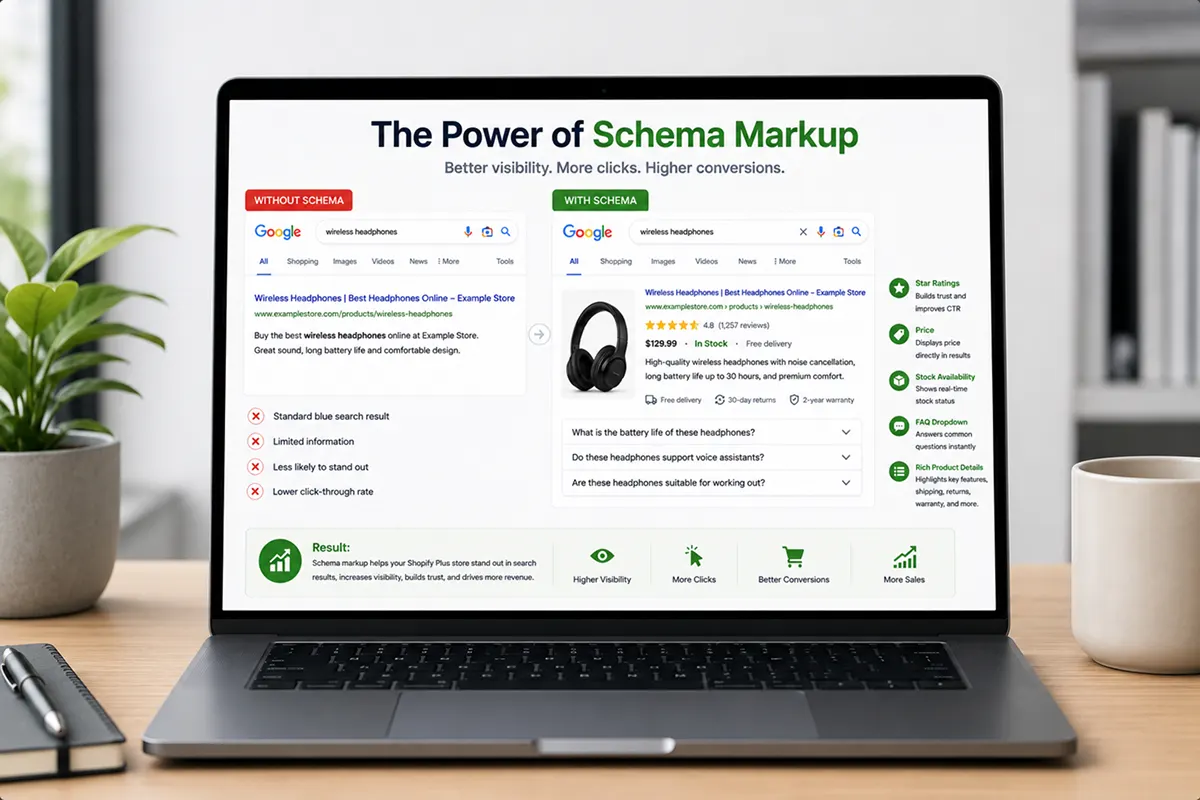
When implemented correctly, structured data increases your chances of earning rich search results that stand out in Google.
Instead of a simple blue link, your listing may display ratings, pricing, availability, or FAQ dropdowns—making it more attractive to potential customers.
Essential Schema Types for Shopify Plus
Product Schema
Displays:
- Product name
- Price
- Availability
- SKU
- Brand
- Ratings
Breadcrumb Schema
Helps search engines understand page hierarchy.
Example:
Home → Furniture → Office Chairs → Ergonomic Chair
Organization Schema
Provides business information such as:
- Company name
- Logo
- Contact details
- Social profiles
FAQ Schema
Ideal for product pages, collection pages, and educational content like this guide.
Article Schema
Used for blog posts to improve content understanding and visibility.
Why Structured Data Matters
Benefits include:
✔ Rich snippets
✔ Better click-through rates
✔ Improved understanding by search engines
✔ Enhanced visibility in AI-powered search experiences
Expert Insight
Structured data doesn’t guarantee rich results, but it gives search engines the information needed to display enhanced search features when appropriate.
📲 Need Help Implementing Schema?
We audit and optimize structured data across Shopify Plus stores to improve visibility in search results.
8. Shopify International SEO: How to Grow Organic Traffic Across Multiple Countries
Expanding into international markets creates exciting opportunities—but it also introduces new SEO challenges.
Many businesses assume translating their website is enough.
It isn’t.
International SEO ensures search engines understand:
- Which language your content is written in.
- Which country a page targets.
- Which version should appear for users in different regions.
Without a proper strategy, you risk duplicate content, incorrect indexing, and poor visibility in global search results.
Common International SEO Challenges
Enterprise Shopify Plus stores often struggle with:
- Duplicate localized content.
- Missing or incorrect hreflang implementation.
- Weak localized keyword research.
- Poor URL structures.
- Currency confusion.
- Inconsistent metadata.
- Country-specific content gaps.
These issues can reduce visibility even when the products themselves are excellent.
Best Practices for Shopify International SEO
Use Shopify Markets Strategically
Shopify Markets helps merchants manage multiple countries and currencies from a centralized platform.
Configure markets carefully so customers see the most relevant content, pricing, and language.
Perform Local Keyword Research
Customers in different countries often search differently.
For example:
Sneakers
Trainers
Running Shoes
The intent is similar, but the language changes.
Optimizing for regional search terms improves relevance and visibility.
Localize Content
Avoid machine-translated pages without review.
Instead, adapt:
- Product descriptions
- Collection content
- Blog articles
- Metadata
- CTAs
- FAQs
Localization creates a more natural experience for users in each market.
Optimize Metadata by Region
Different countries often require different messaging.
For example, a title targeting U.S. shoppers may emphasize free shipping, while another market might prioritize local availability or fast delivery.
Build Country-Specific Content
Consider creating localized resources such as:
- Buying guides
- Seasonal campaigns
- Market-specific FAQs
- Industry insights
- Local success stories
These pages strengthen relevance for each region.
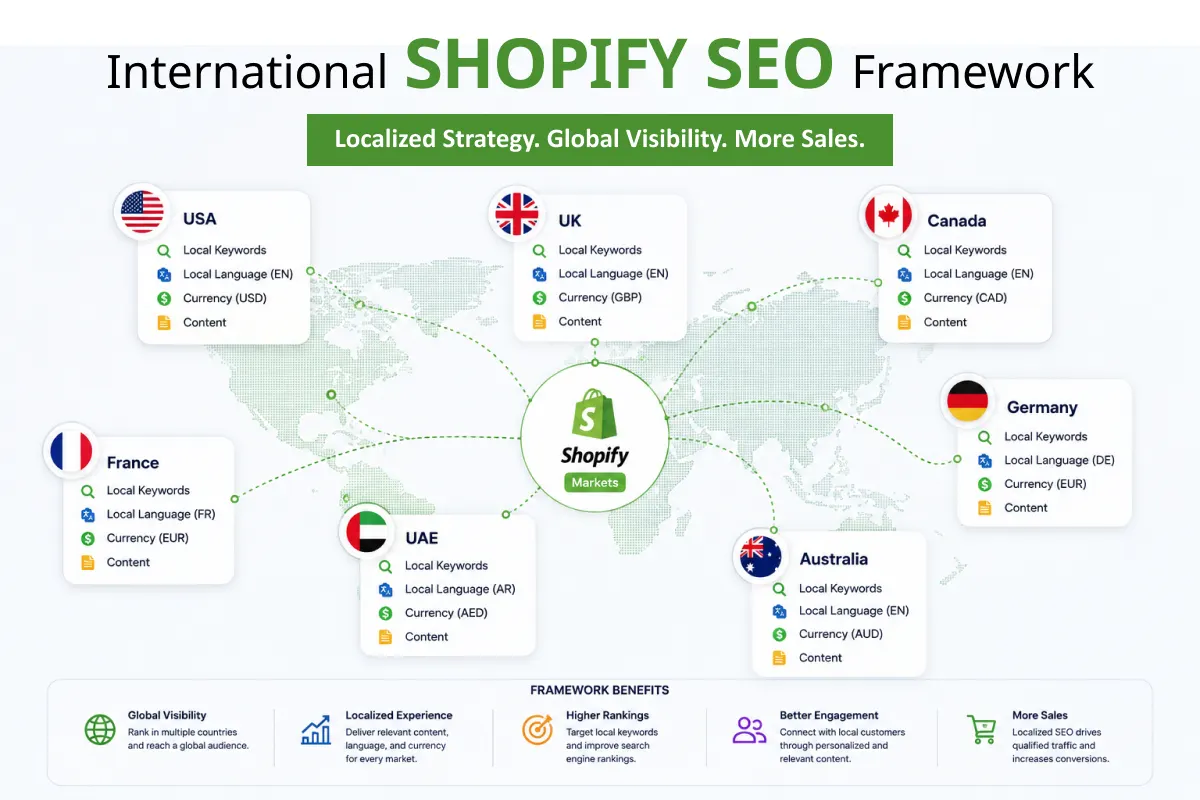
Why International SEO Matters
A strong international strategy helps:
- Reach new markets organically.
- Improve visibility in country-specific search results.
- Deliver a better user experience.
- Increase international revenue.
- Reduce duplicate content issues.
Expert Tip
International SEO is not about copying the same page into multiple languages. It’s about understanding how customers in each region search, shop, and make purchasing decisions.
📲 Planning International Expansion?
Our Shopify International SEO specialists help businesses optimize multilingual stores, Shopify Markets, localized content, and global search visibility.
9. Improve Core Web Vitals for Better Rankings and User Experience
Have you ever clicked on a website that took too long to load?
Most visitors won’t wait.
In eCommerce, even a one-second delay can impact user satisfaction and conversions.
That’s why Google introduced Core Web Vitals—a set of performance metrics that evaluate how quickly and smoothly users can interact with your website.
For Shopify Plus stores with large catalogs, videos, third-party apps, and high-resolution imagery, maintaining strong Core Web Vitals requires ongoing attention.
We’ll explore exactly how to improve these metrics, identify common performance bottlenecks, and prioritize fixes in the next section, along with a complete Shopify Plus SEO Audit Checklist that enterprise brands can use to evaluate their stores.
Insight
As we’ve seen, Shopify Plus SEO is about much more than keywords. From image optimization and structured data to international SEO, every improvement contributes to better search visibility and a stronger shopping experience.
Next, let’s explore how Core Web Vitals and a comprehensive Shopify Plus SEO audit can help identify performance issues and unlock new organic growth opportunities.


